Watch · 1 minute
See a flaky test go from first flake to proven fix
A coupon test fails and passes on the same commit. Drape flags it, quarantines it, finds the commit that made it flaky, and proves the fix with 50 green runs. Captions are on screen, so it works muted.
Read the transcript
Flaky tests waste your team's time, and your AI agents' time too.
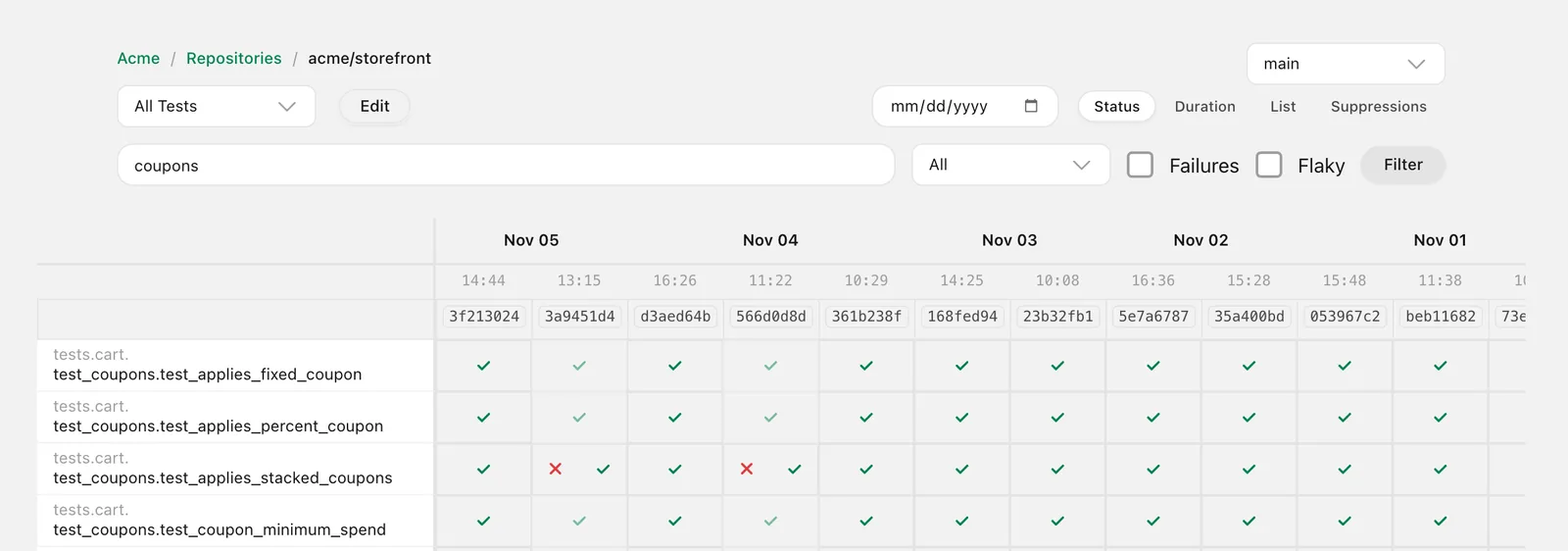
This coupon test failed, then passed on retry, on the same commit. It's flaky, not your change.
Drape flagged it the day it turned flaky, and counts the CI time it's wasting.
To unblock your pull requests while it gets fixed, you can quarantine it. Give it a reason, an expiry, and a ticket, and it keeps running without blocking anyone.
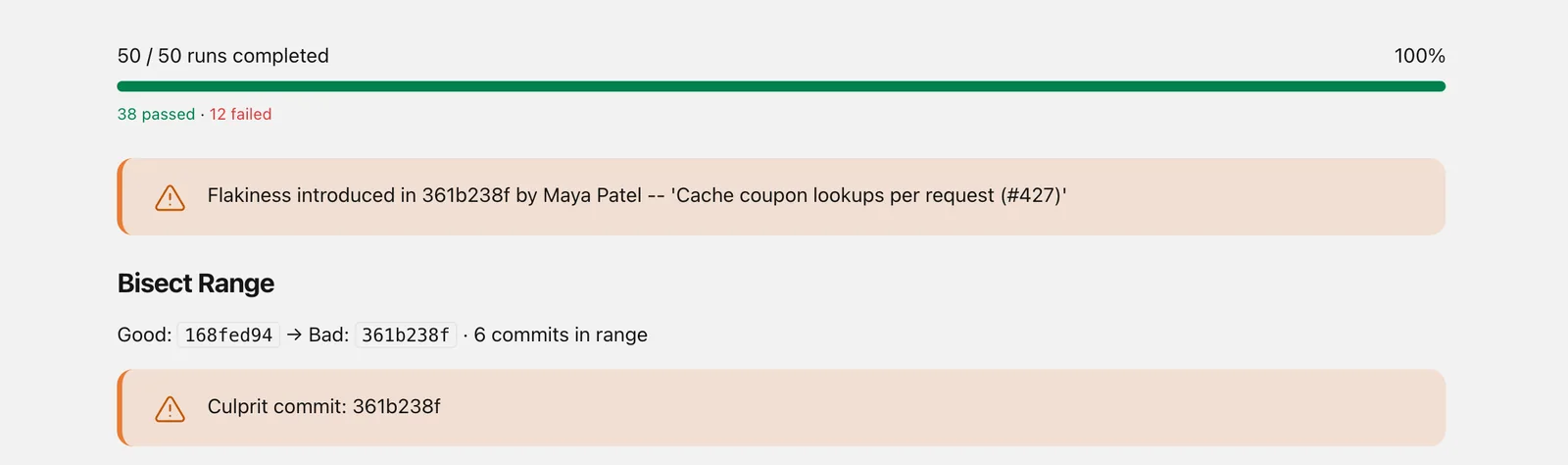
Then find out what broke it. Drape reruns the test across your recent commits, and names the change that made it flaky.
Through Drape's MCP server, Claude Code or Codex learns the failure is a flake, reads the test's history, and goes straight to the fix.
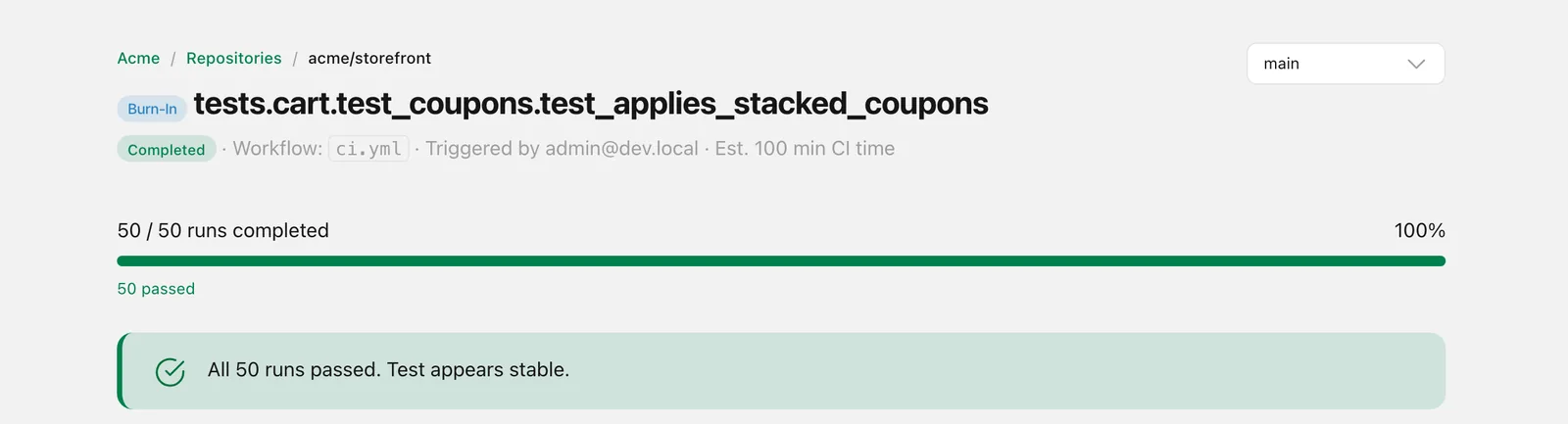
Once the fix lands, burn it in. Fifty runs, fifty passes, so you know it's fixed, not just lucky.
Lift the quarantine, and main stays green, for real this time.
Drape. The CI brain.
Why teams live with the problem
“Just rerun it”
The default response to a flaky test. It feels fast in the moment, but it normalizes unreliable CI. Developers stop investigating failures and start treating every red build as noise.
“It's not a priority”
Flaky tests are hard to prioritize because no single flake is catastrophic. Added up, they cost hours every week. Without a number for that cost, the fix never makes it onto the roadmap.
“We'll fix it later”
Later never comes. Flaky tests accumulate, CI gets slower, and the test suite becomes something teams endure rather than trust. By the time it's a crisis, fixing it is a multi-quarter project.
What happens when CI loses trust
Your AI agents learn the habit too
An agent that sees a test fail and then pass on a rerun moves on. Without flake history it can't tell a flaky failure from a real one, so it retries blindly or punts back to a human.
Nobody knows where the CI time goes
Retries, queue wait, flakes: without a breakdown, nobody can see which one is eating your CI time, so the fix that saves the most hours never gets built.
Merge queues become bottlenecks
Every PR waits for reruns, so features that should ship in hours take days.
Real failures get written off
Once a red build is usually noise, people rerun failures before reading them, and the real bug gets written off as “probably flaky” too.
From the first flake to a proven fix
One flaky coupon test in a demo storefront, from the day it turned flaky to the day main went green for good. Every screen is the Drape product.
Detect
Flag it the first time it flakes
A test that fails, then passes when the same commit runs again, is flaky. It isn’t your change. Drape flags it the day it happens, scores how often it flakes on your default branch, and counts the CI time it costs.
Unblock
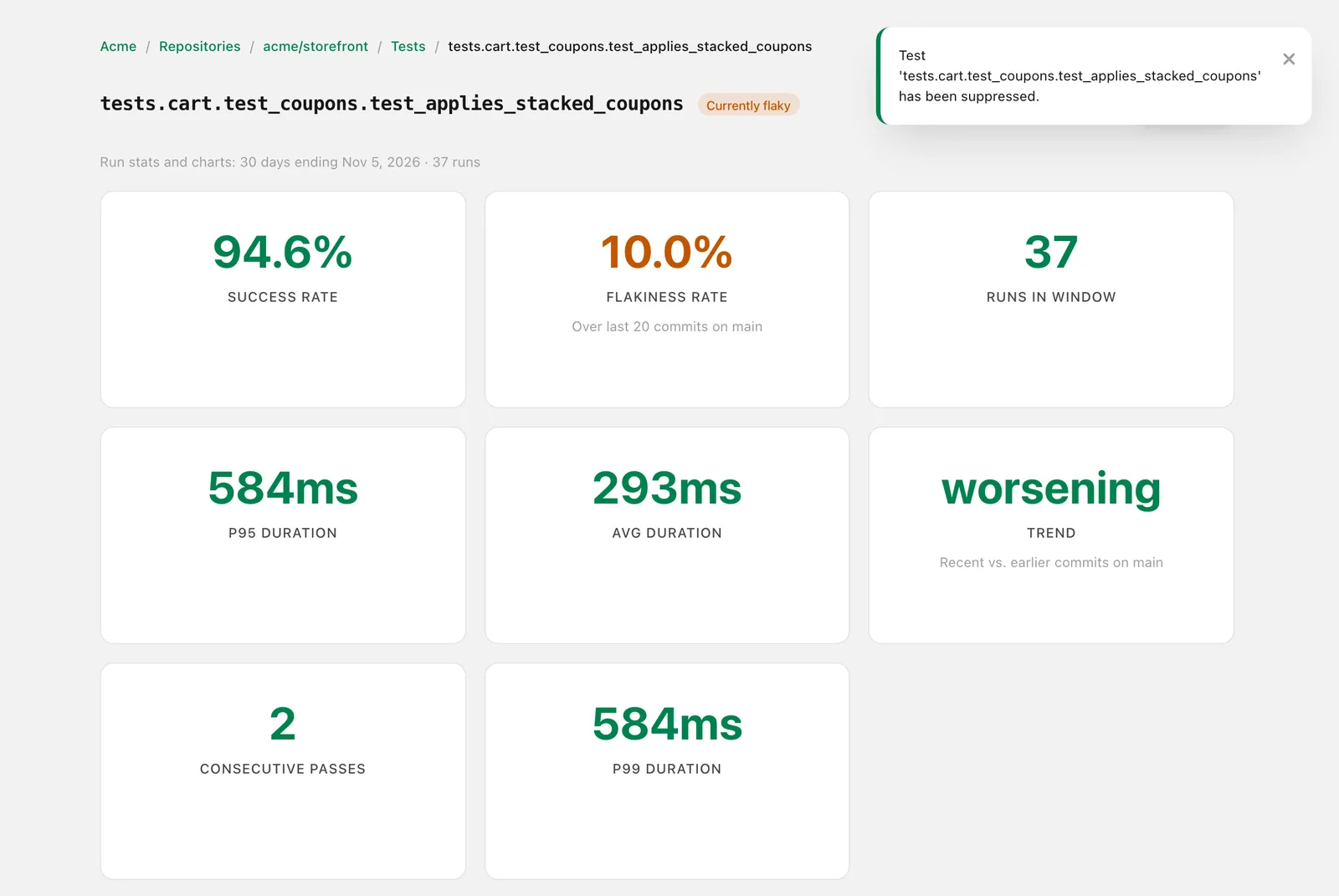
Quarantine it, with an expiry
Give it a reason, an expiry date and a ticket. The test keeps running, but it stops blocking pull requests while it gets fixed. Drape calls this a suppression, and it works for flaky CI jobs too.
- Suppress on
mainonly, onfeature/*, or everywhere - Suppressions end on their expiry date unless someone renews them
- Anything suppressed for 30+ days with no progress gets flagged
Find the cause
Find the commit that made it flaky
Drape reruns the test across your recent commits and names the change that introduced the flakiness, so nobody walks the history by hand.
Fix
Your agent fixes it instead of re-running it
Through Drape’s MCP server, Claude Code, Cursor or Codex asks whether a red build is a real bug or a flake, and reads the test’s history, so it goes straight to the fix.
~/acme/storefront $ claude
> CI is red on main. Is it my code? Fix it.

● drape · triage_ci(repo="acme/storefront")
  test_applies_stacked_coupons: flaky, not your change
● drape · get_test(test="test_applies_stacked_coupons")
  flaky on 10% of main commits · trend worsening
  assert Decimal('42.50') == Decimal('37.50')

● Reading src/storefront/cart/coupons.py
  The coupon cache is shared across carts, so a
  stacked cart reads another cart's lookup.

- _cache[code] = lookup(code)
+ _cache[(cart.id, code)] = lookup(code)
Prove
Prove the fix with 50 green runs
Once the fix lands, burn it in: Drape runs the test 50 times on the same commit. Fifty passes means it’s fixed, not lucky. Lift the quarantine, and main stays green.